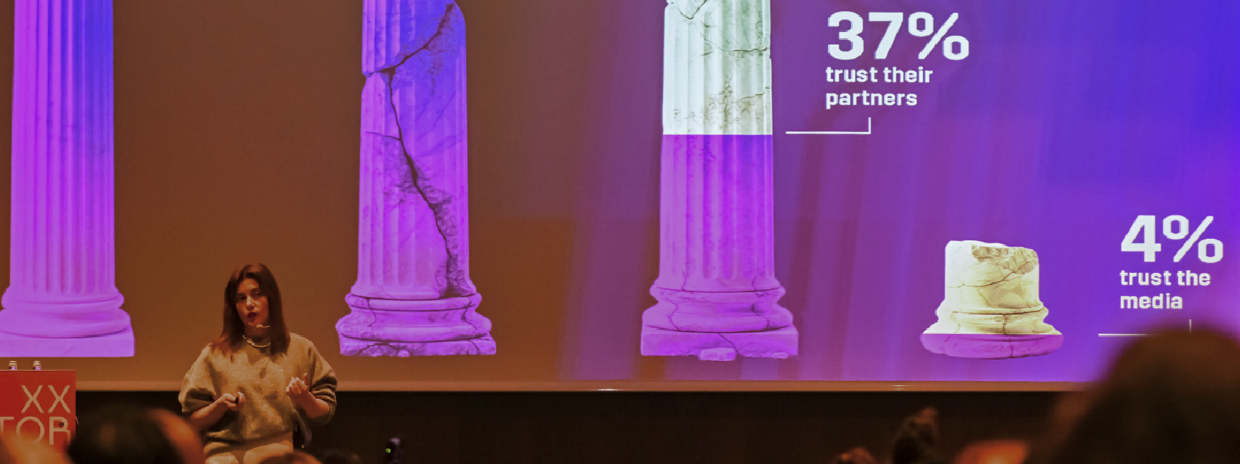
Bulgaria has no large-scale, nationally representative data about women, from women, that connects demographics, health behaviors, social roles, psychological wellbeing, and economic position in one continuous picture. Most public health data is aggregate. Most policy is designed for a statistical average that erases gendered experience. There is something quietly radical about deciding to ask. Not to assume, not to extrapolate from aggregate data that folds women into households and households into averages and averages into policy, but to actually ask. To design a study around the premise that women's lives, in their full complexity, are worth knowing about.
Much Better commissioned this study because we understand that before you can say anything true about a woman's life, you have to be willing to look at it without the softening of the marketing lens, without the convenient story, without the aspirational frame that turns exhaustion into grit and time poverty into productivity. This is the premise of femvertising at its most serious and most honest - not the performance of empowerment, not the aesthetic of strength deployed to sell something, but a genuine reckoning with the conditions of women's lives as they are actually lived. The study is, in this sense, a refusal to flatten, to simplify, to choose the version of the Bulgarian woman that is easiest to address. It insists on the complicated one.
Because data often focuses on the male body and male experience, the “average” person is assumed to be male - making women invisible in politics, medicine, AI, etc. When data is incomplete, the policies and institutions built on it produce systematically unequal outcomes in real life - from poorer medical diagnoses and riskier working conditions to unfair access to bank credits, less safe urban environments, and more.
Data plays a key role in decision-making and policy-shaping, which makes it essential that it accurately represents the people it aims to serve.
And here’s a pinch of our key findings:
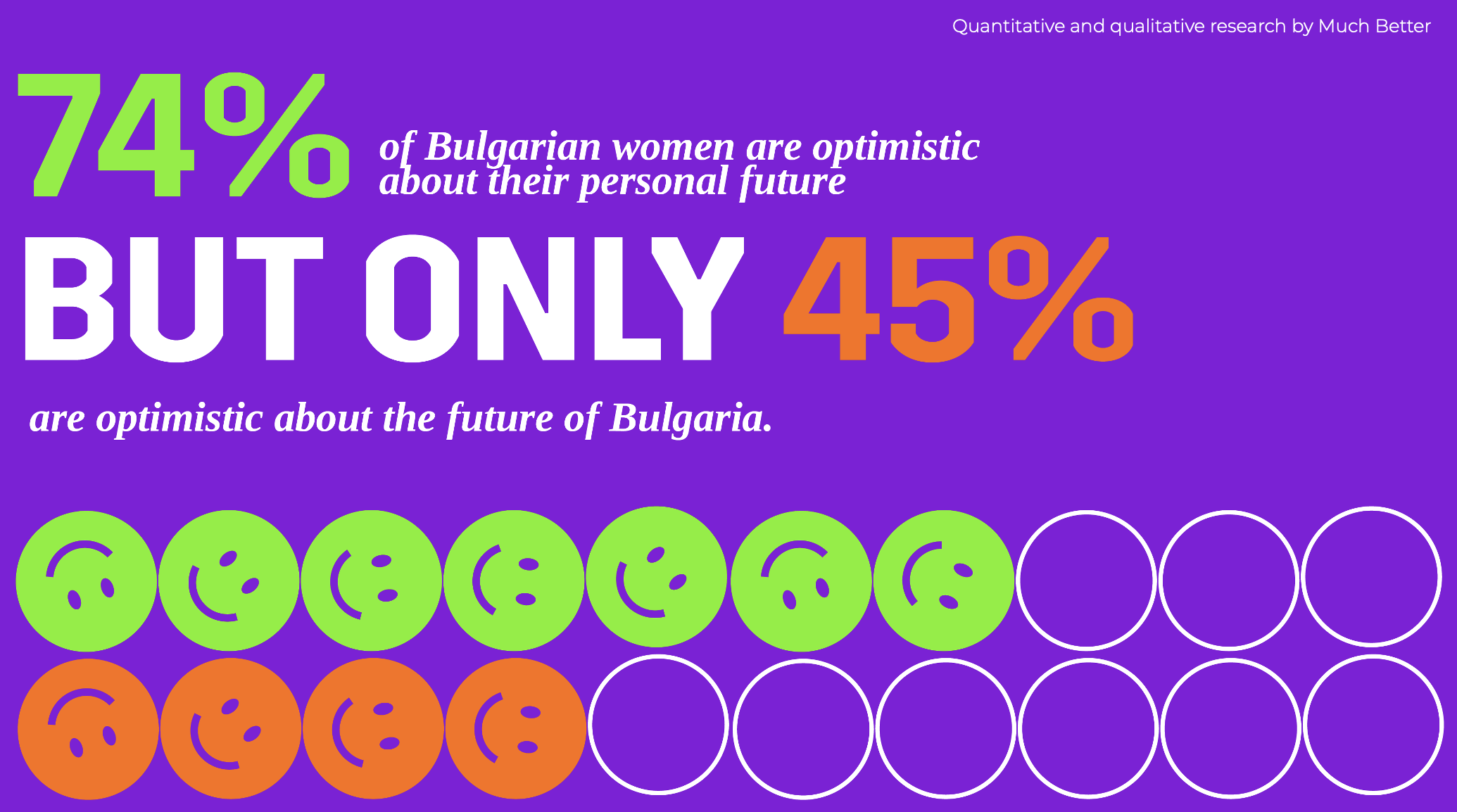
We are witnessing a generational shift in values – from survival to self-actualization. 74% of Bulgarian women are optimistic about their personal future. Yet only 45% are optimistic about Bulgaria's future. In other words, Bulgarian women have greater confidence in themselves than in the system. This higher level of personal optimism suggests that initiatives - whether marketing, political, or social - that emphasize personal growth, self-improvement, and individual aspirations are likely to resonate particularly strongly with women.
Bulgaria has no large-scale, nationally representative data about women, from women, that connects demographics, health behaviors, social roles, psychological wellbeing, and economic position in one continuous picture. Most public health data is aggregate. Most policy is designed for a statistical average that erases gendered experience. There is something quietly radical about deciding to ask. Not to assume, not to extrapolate from aggregate data that folds women into households and households into averages and averages into policy, but to actually ask. To design a study around the premise that women's lives, in their full complexity, are worth knowing about.
Much Better commissioned this study because we understand that before you can say anything true about a woman's life, you have to be willing to look at it without the softening of the marketing lens, without the convenient story, without the aspirational frame that turns exhaustion into grit and time poverty into productivity. This is the premise of femvertising at its most serious and most honest - not the performance of empowerment, not the aesthetic of strength deployed to sell something, but a genuine reckoning with the conditions of women's lives as they are actually lived. The study is, in this sense, a refusal to flatten, to simplify, to choose the version of the Bulgarian woman that is easiest to address. It insists on the complicated one.
Because data often focuses on the male body and male experience, the “average” person is assumed to be male - making women invisible in politics, medicine, AI, etc. When data is incomplete, the policies and institutions built on it produce systematically unequal outcomes in real life - from poorer medical diagnoses and riskier working conditions to unfair access to bank credits, less safe urban environments, and more.
Data plays a key role in decision-making and policy-shaping, which makes it essential that it accurately represents the people it aims to serve.
And here’s a pinch of our key findings:
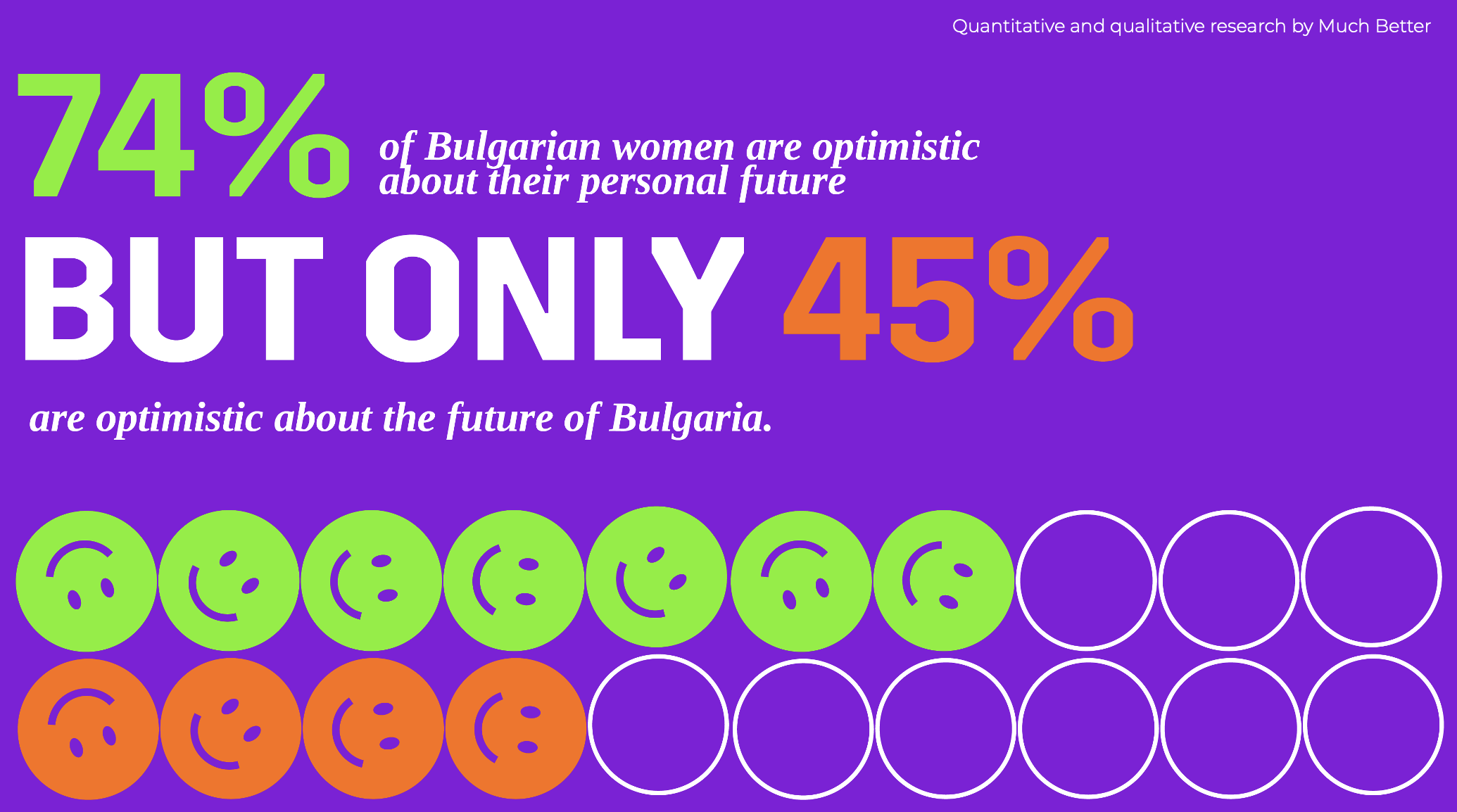
We are witnessing a generational shift in values – from survival to self-actualization. 74% of Bulgarian women are optimistic about their personal future. Yet only 45% are optimistic about Bulgaria's future. In other words, Bulgarian women have greater confidence in themselves than in the system. This higher level of personal optimism suggests that initiatives - whether marketing, political, or social - that emphasize personal growth, self-improvement, and individual aspirations are likely to resonate particularly strongly with women.